How many Wizards are there in Harry Potter?
I always assumed there were a lot of witches and wizards in Harry Potter, but I think I was wrong.
Harry Potter
Harry Potter, a series of Young Adult fiction books by JK Rowling, was an integral part of my childhood. The series was released from 1997 to 2007. When I started reading the books as a kid, there were only 4. I went with my family to midnight release parties for books 5-7.
Those books played an enormous part in my childhood. Our family had the books on cassette tape (and later on CD). Every time we'd take a road trip, we'd listen to Jim Dale read one or more of the books. I read or listened to the books at least 10 times each (probably more for the first few).
These books had a huge impact on my little imagination. I built Harry Potter Legos, played Harry Potter with my friends, and drew Harry Potter art. I collected Harry Potter trading cards, and ate Harry Potter candy.
As the series went on, Harry grew up and so did I. In a very real way, we went through our adolescence together. Movies followed the books, and I watched those as they came out as well. All that to say, the Harry Potter series had a huge influence on me growing up.
Revisiting the Books
Recently, I realized it had been over a decade since I'd read a Harry Potter book, and I thought they would be fun to revisit as an adult. I put all of the audiobooks on hold at my local library, and I have been working my way through them.
It's been fun to revisit these books. They've been super nostalgic, and I've loved experiencing the stories with a new perspective. As an adult, I identify less with Harry, and more with the teachers and other adults in the stories.
As I worked my way through the series, I realized that some of my assumptions about the scale of the wizarding world (that I developed as a child) are flat-out wrong. Specifically, I was wrong about the scale of the magical community. I always assumed that 1 in 10 or maybe 1 in 100 people were witches and wizards in the Harry Potter world.
There are Fewer Wizards in Harry Potter than I Thought
When I was little, I imagined the wizarding world to be a slightly smaller version of the non-wizarding world. Maybe 1 witch or wizard for every 10 muggles (non-magic people). As I reread the books, that didn't seem right, so I set about gathering data.
Note
I realize the Harry Potter books are essentially kids' books, and you shouldn't take them too seriously. Not everything JK Rowling wrote in these books had some secret meaning, and while she was attentive with worldbuilding, everything doesn't have to fit together perfectly to enjoy the stories. That being said, we can infer a bunch about the wizarding world from the books, which is what I'm going to do. I am only drawing from the seven Harry Potter books, and not other Harry Potter sources. (Like movies or games)
Preliminary Info: Places and Dates
If we want to use population estimates, we first need to anchor ourselves. The Harry Potter series takes place in the 'real world'. We are led to believe that everything that happens in the Harry Potter books is taking place in a parallel version of England that closely resembles the real one.
The books also tell us exactly when they take place. We know from Harry's parents' tombstones that they died on Halloween, 1981 (both born in 1960). Harry was a baby. Harry started school in the 1991-1992 school year (Sorcerer's stone), and the last book takes place in 1997-1998.
During those years, the total UK population was between 57,000,000 and 60,000,000. The total UK fertility rate in 1980 (when Harry was born) was 1.9 children per woman.
How Many Students are there at Hogwarts?
This is a hotly contested issue. Fans of the series have been battling this out for a while.
Why do we even care about this? Well, most wizarding children from the UK would've gone to Hogwarts. In HP7, Remus Lupin says, "Of course, nearly every witch and wizard in Britain has been educated at Hogwarts, but their parents had the right to teach them at home or send them abroad if they preferred" So an estimate of Hogwarts students can give us an estimate of the total youth population of the wizarding world we can use to extrapolate the full population. Because most of the Harry Potter series takes place at Hogwarts, it is likely to be the best source to base our estimate on.
We see that even anti-establishment wizards (like Xenophilius Lovegood, who self-publishes the Quibbler, an alternative magazine) send their children (Luna) to Hogwarts rather than training at home. So it is safe to assume that at least 95% of wizarding children are at Hogwarts.
We also assume that Hogwarts is the only wizard school in the UK, and there is good evidence of this throughout the books. In HP4, Hogwarts holds the triwizard tournament, where they have students from Beaubaxtons (France) and Durmstrang (Eastern Europe including Bulgaria). No magic schools nearer than France are ever mentioned. We hear about Scottish and Irish wizards attending Hogwarts, so we don't have much reason to believe Ireland or Scotland have their own schools.
So how many students are there? We know that all of the students can fit in one large room at 4 long tables (in the great hall). Also, the full student body fits on a single train (the Hogwarts Express). We also know that Hogwarts has at most one teacher per subject (with the exception of divination in the later books). There don't seem to be more than 15 teachers (excluding the gamekeeper, librarian, etc) for a total of maybe 25 adults in the castle. Logistically, this all points in the direction of a small student body.
We can also do some back-of-the napkin math to get a very rough estimate of how many students there are. There are 5 Gryffindor boys in Harry's year (Harry Potter, Ron Weasley, Seamus Finnegan, Dean Thomas, and Neville Longbottom.) If we assume there are 5 boys and 5 girls in each house in each year we get:
10 students x 4 houses x 7 grades = 280 total students.
Getting ahead of this: JK Rowling once said that Hogwarts had 1000 students, but this was an offhand comment in an interview before she had even written half of the books. We're going to ignore that and instead focus on the evidence in the books themselves.
We get another hint as to the size of the student body as the students go up to the castle in carriages. In HP4 that 'a hundred' horseless carriages are transporting the students. If that number isn't a generalization, (which it may be) and we assume there are 2-4 students in each carriage, this gives us between 200 and 400 students.
Based on both of these, I'm going to go ahead and assume there are about 300 students at Hogwarts.
Do Wizards and Non-Wizards Have Similar Birthrates?
If we want to use UK data, we need to be sure that the real-world birth trends match that of the wizarding world. Like I mentioned above, the UK birthrate in 1980 was 1.9 children per woman. Does Hogwarts seem to have similar rates?
Siblings at Hogwarts
While the books do not give us a full account of each student, we do hear about several wizard families. Padma and Pavarti Patil are sisters. Colin and Dennis Creevy are brothers. The Weasleys have seven children. Aside from these, none of Harry's classmates seem to have siblings - and many of them are explicitly only children (Harry, Neville, Hermione, Malfoy, Luna, etc.)
Based on this, it seems like at the time of Harry's attending Hogwarts, the wizard birthrate is lower than the general UK birthrate.
Low Birthrates
When Harry was at Hogwarts, many of his fellow students would've been born during a war against Voldemort and the Death Eaters. Several studies have shown that war decreases fertility rates. So we should assume that in the years before and up to Harry's birth, fertility rates were artificially low due to the war.
And there's evidence of this in the books. Harry's parents couldn't have had more children because they were killed. Neville's parents couldn't because they were tortured to insanity.
Older wizarding generations also have evidence of more siblings. Even though we don't hear too much about older generations, we know that several of them had siblings. Sirius Black had a brother, Dumbledore had two siblings, and Narcissa Malfoy had a sister. So it seems okay to assume that the TFR (Total Fertility Rate) of the general UK would match the TFR for wizards in earlier generations. We'll assume it was closer to 2 (the UK historical TFR for the preceding decades).
Based on all of this, I think we should assume a lower birthrate around the late '70s and early '80s, closer to 1.2.
Doing the Math
We make the following assumptions:
- There are roughly 300 students at Hogwarts.
- 95% of UK students who could attend Hogwarts do.
- Hogwarts is the only wizard school in the UK.
- The normal wizarding birthrate matches the UK birthrate trends, which would put it around 2 before the war with Voldemort.
- The decade leading up to Harry's birth (Voldemort's rise and war) had a lower TFR (around 1.2)
300 children at Hogwarts gives us 315 total UK Wizarding Children (including homeschooled children). Let's do the math with a 1.2 TFR. First, we need to find the annual births for Harry's Hogwarts Cohort:
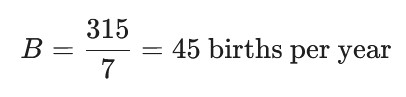
Then, we need the annual births per woman. If we assume a standard 35-year fertility window, we get the following:

From there, we can estimate the total number of women of childbearing age in the population. We do this by dividing the births by the rate.
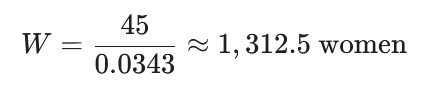
Finally, we assume that women of childbearing age make up about 25% of the full population.
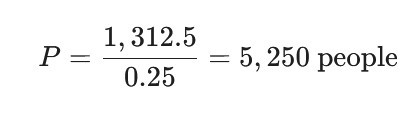
This gives us an estimate around 5,250 wizards. However, this uses depressed fertility estimates. If we assume higher fertility rates before and after, this would give us an estimate between 6,000 and 7,000 total witches and wizards in the UK.
Does this Estimate Work?
So if we assume 6,000ish wizards in the UK, does this fit with the greater wizarding world we read about in the books? I think the evidence points to yes.
Settlements
In HP3, we learn that Hogsmeade, the village by Hogwarts, is the only fully-wizarding settlement in Britain. There are other communities with multiple wizard families in them (like Godric's Hollow), but there's not a large enough population to support multiple all-wizard villages.
Infrastructure
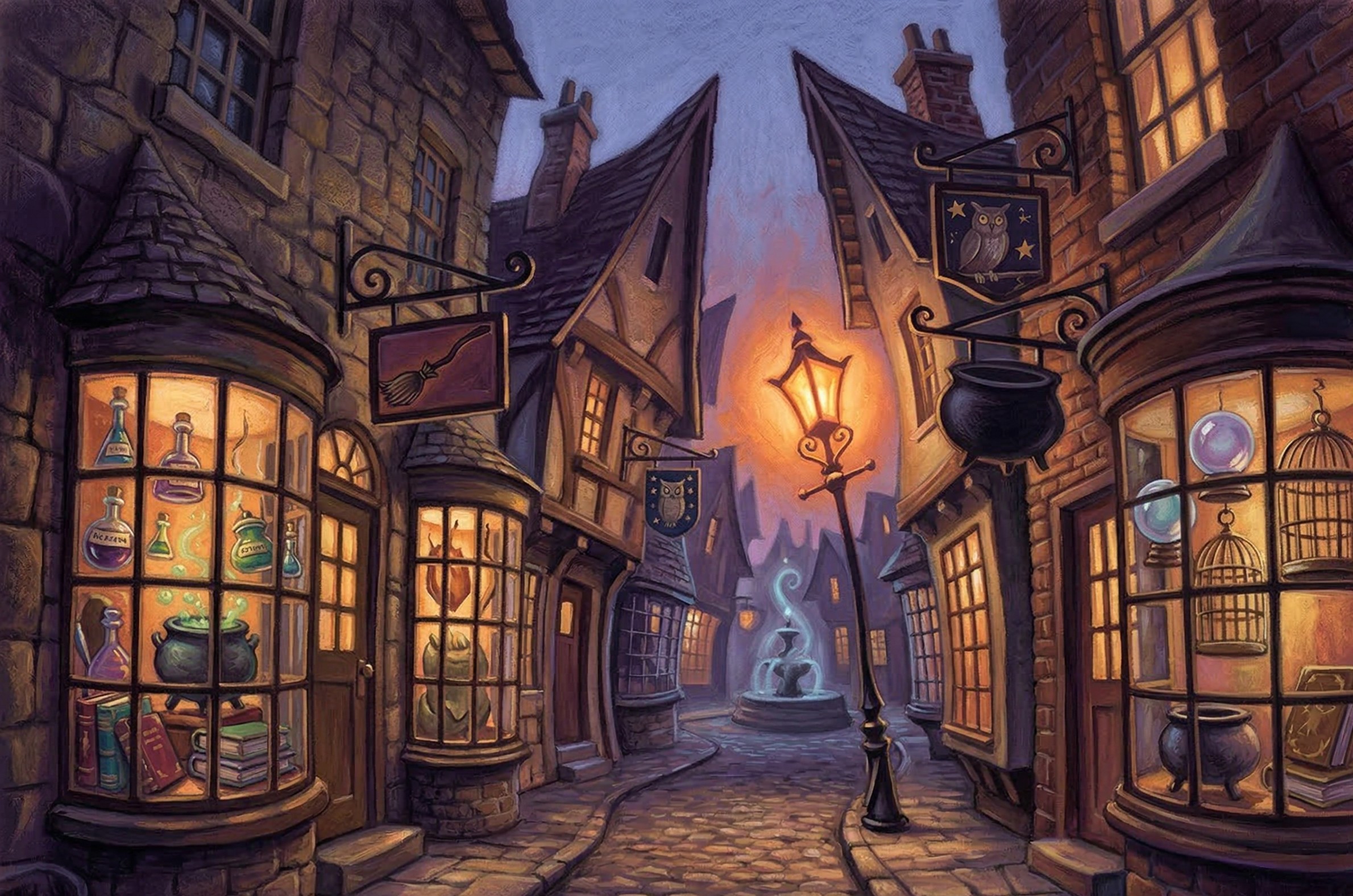
The small-scale of the Wizarding World is also hinted at in the magical infrastructure. Only one shop, Ollivander's, supplies wands to all of the wizards in Britain. There is only ever one magical hospital mentioned, St. Mungo's. Diagon Alley seems to be the only wizard shopping street in all of London. Gringott's is the only wizarding bank. There is only one wizard prison, Azkaban. In HP2, when Hagrid is removed from the school, he's taken to Azkaban as a precaution, suggesting there is no lower-security prison or jail for suspects.
We also get a hint of this in HP3, when the Weasley family winning a raffle and going on vacation with the money is front-page news for the wizard paper. If there were more going on, that probably wouldn't have made it onto the front page.
Relationships
All the wizards in Harry Potter seem to know each other (roughly). Lucius Malfoy can identify a Weasley child by sight, and has talked about their family enough for Draco to have prejudice against them before meeting any of them at school. Ron recognizes several wizard families by name, even if he hasn't met anybody from them. When the characters go to the Quidditch world cup in HP4, Mr. Weasley knows almost everyone by sight, suggesting a tight-knit community. Later, in Grimauld Place, we see a family tree of wizarding families that encompasses several families encountered previously in the books. Additionally, Horace Slughorn mentions knowing students from having taught their parents or other relatives. All that suggests a small, interconnected social network.
Government
We also have an idea that the wizarding population is fairly small because of the size of the ministry of magic. While the building itself has several levels, the departments themselves are small. Mr. Weasley works for the Misuse of Muggle Artifacts office, which is a department of him and only one other wizard. He reports directly to the minister of magic, suggesting a relatively small government bureaucracy.
On top of this, the minister of magic seems much less like a prime minister/president, and more like a mayor. He doesn't bring security with him, and people treat him rather informally when they meet him in settings like pubs.
Taken together, the small infrastructure, lack of wizard settlements, social relationships, and small government all support a magical population of around 6,000.
Conclusion
Harry Potter is a series of kids' books, and I'm sure nobody ever intended them to be taken so seriously. However, if my assumptions about the wizarding world are correct, it seems like there might have been around 6,000 witches and wizards in the UK during the Harry Potter series. Considering there were about 60,000,000 total people in the UK, that would mean roughly 1 in 10,000 people in the UK was magical. My childhood estimates of 1 in 10 or 1 in 100 were off by multiple orders of magnitude.