Boys of Bluegrass
I recorded my first bluegrass song
Recording Music
I've been recording songs for 13 years. In 2013, while a freshman at BYU, I wasn't sure what to get my mom for Mother's Day. I was a very poor student, so buying something nice was out of the question. I decided to go for a craft (a classic mom gift.) More specifically, a song.
I spent several hours recording a cover of 'Dear Mama' by Tupac. It didn't sound good, but it was silly. My mom loved it, and I've recorded lots of songs since. I'm not an amazing singer, but I've enjoyed getting better at making music over the years.
'80s Music
There's a soft spot in my heart for '80s music. This is the music my parents were listening to in high school, and it's emblematic of their movies, like Sixteen Candles and Pretty in Pink.
Lately, I've been enjoying music from that era that I consider almost melancholy. Think songs like Peter Gabriel's 'In Your Eyes' or Don Henley's 'Boys of Summer'. As I've been listening to these songs, I've been singing along, harmonizing with the melody. I figured out a second voice to the chorus of 'Boys of Summer', and wanted to try and record it.
Of course, I didn't want to make a 1:1 copy. I'm a worse musician than Don Henley. If I wanted my song to be more than a bad copy, I'd need to put my own spin on it.
Bluegrass
Around this time, Bluegrass music has been creeping into my awareness. I feel like I've been seeing a lot of it on social media, and I heard a live bluegrass group at a recent church activity.
While working on this song, I learned that bluegrass is a relatively new type of music. It started in the 1940s, which makes it less than 10 years older than Rock and Roll. Bluegrass is characterized by its twangy sound and rolling banjo.
Typically, a bluegrass ensemble includes the following instruments:
- Banjo
- Mandolin
- Guitar
- Fiddle
- Bass
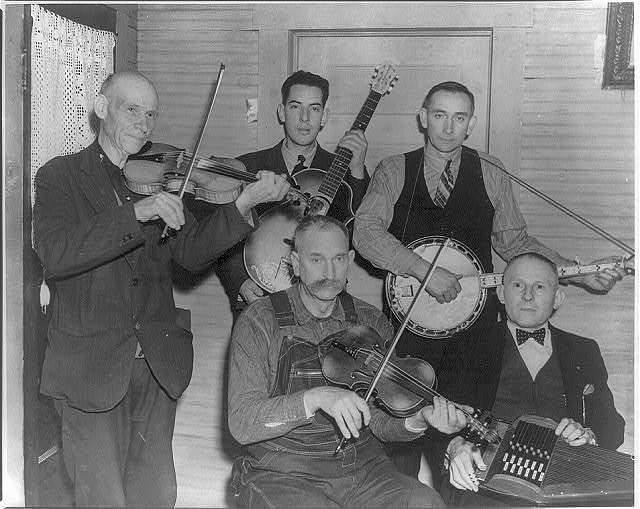
One thing these instruments have in common is that most of them are easy to synthesize with reasonably high fidelity. A plucked banjo sounds much more realistic when synthesized than a bowed cello, for example. While the fiddle could be a little tricky, all the other instruments would sound quite good when synthesized.
Arranging
I decided to put the arrangement together in MuseScore, which I've used for several of my previous projects. The built-in synthesizers work great for a song like this.
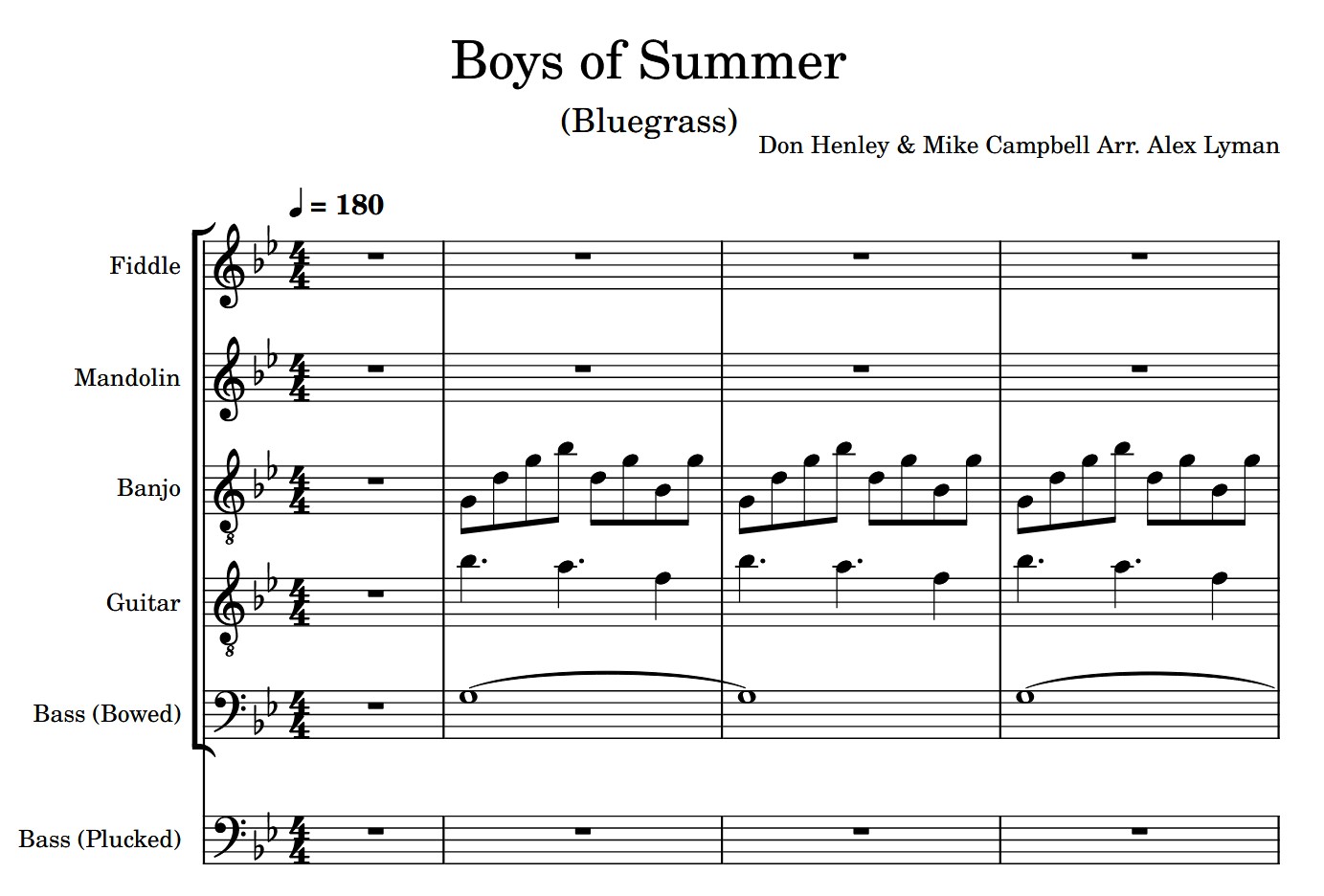
I set up a score with the traditional bluegrass ensemble, and thought hard about how to translate the '80s synth parts into bluegrass. Here's what the intro to the original song sounds like:
For the bluegrass version, I replaced the synth bass drone of the original with a bowed bass, and the synth tresillo with the guitar. Where the original song used a rhythm guitar, I used the fiddle. To give my version that distinct bluegrass feel, I composed and added in a rolling banjo line. (I also changed the key to match my vocal range instead of Don Henley's.)
That felt like a perfect fusion between the original song and the bluegrass genre. For the chorus, I leaned heavily into the traditional bluegrass sound, with the bass playing the beats 1 and 3 and the mandolin and guitar playing chords on 2 and 4, while the banjo rolled and the fiddle swayed over the top of the arrangement. This has the classic "Boom-Chuck" feel that defines bluegrass.
As always, you can download the sheet music for the instrumentals here. If you end up playing this in your bluegrass band, please let me know. I'd be delighted.
Recording
Recording the vocals was fun. Obviously, I'm not a great bluegrass vocalist, but I had a good time trying to mimic the Appalachian twang. I also liked putting the two- (and three-) part vocals together for the chorus. Since I was going for a folksy, twangy tone, I felt less pressure to sing perfectly than I usually do. I could let imperfections shine as a feature of the song. This made the recording process much more enjoyable. I even left in a voice crack for authenticity.
I have a nice-enough microphone I got for remote work during COVID, and it's way better than the laptop mic I used for my first few mother's day songs. I was able to record the song and do basic effects (compression, reverb, etc) in audacity.
The original song is long, like almost five minutes. A lot of that is instrumental breaks, and I omitted all of those from my version. I also upped the tempo by a few BPM, which felt more in line with the upbeat bluegrass sound I was shooting for. TAfter all that, my version was closer to three minutes.
Autotune
Each time I record a song, I try and learn a new skill associated with music editing and producing. This time, I wanted to try applying autotune. Now, when people hear the word autotune, they tend to think of a strong, vocoder-like sound (think T-Pain). However, every pop song you hear is subtly autotuned to a degree you can't perceive, but it's part of what makes songs sound professional. Even live performances often have live autotune to smooth out vocal wobbles. I downloaded Melodyne, an industry standard autotune program (that offers a 30-day free trial), and cleaned up my vocals. I didn't do a perfect job, but it sure makes the chorus mesh a lot better than it used to before I edited it.
Autotuning (pitch correction if we're being technical) is a lot of work. I had to individually adjust hundreds of notes across the song. It took a couple of hours. I had always imagined the process as clicking a 'fix my singing' button, but that's not what it's like.
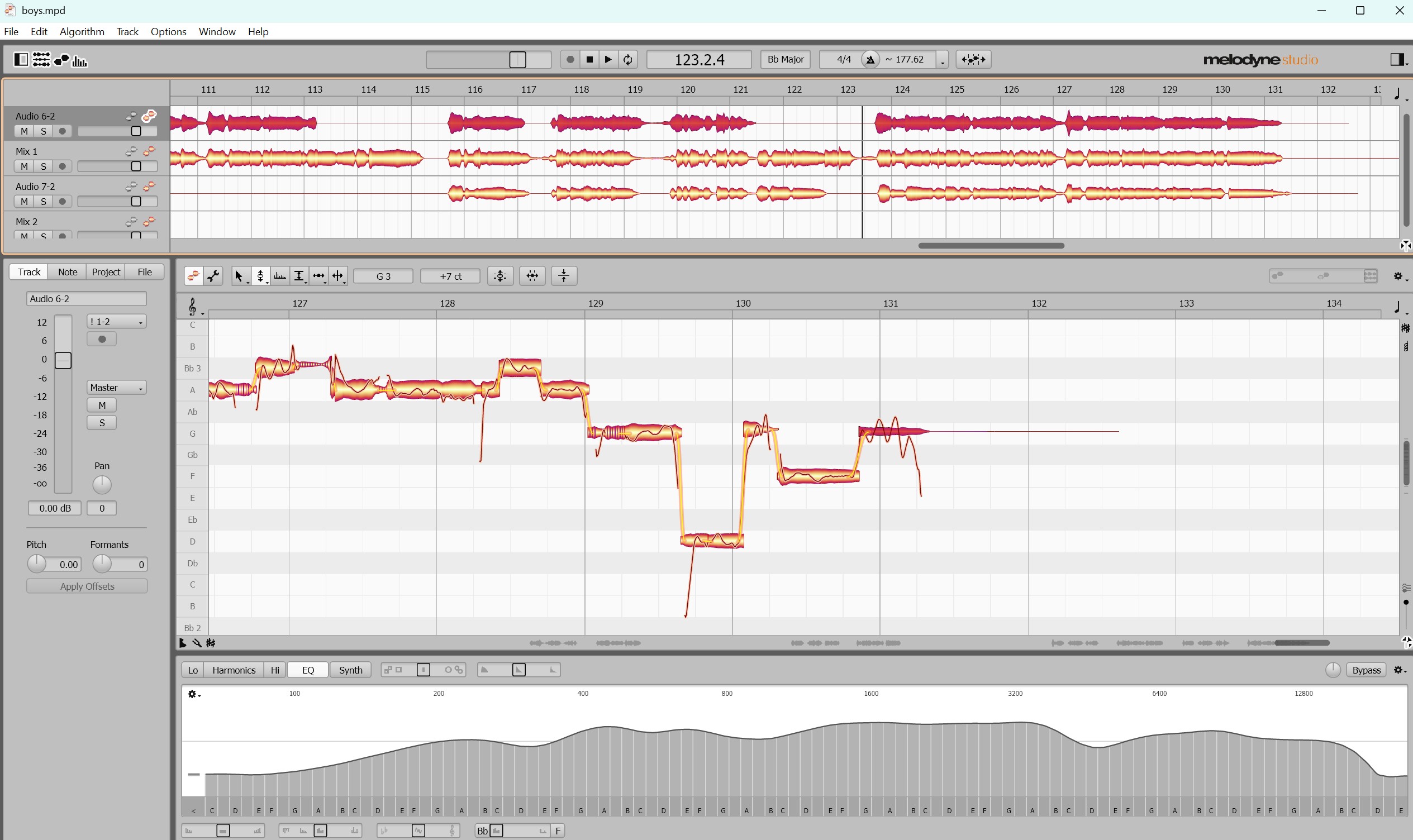
Now when you listen to the full song you might think, "Alex, I thought you autotuned this -- It still sounds bad." It's a common misperception that autotune can make bad vocals sound good. It can't. Autotune can fix notes that are a little off, but doesn't impart nice tone or timbre or any of those things that come with a great singing voice.
Finally, I mixed everything together. I added reverb, balanced the volume and panning, and had a finished song.
The Final Product
The final song turned out great, all things considered. It's so cool that even though I can't play any of the instruments in this arrangement, I was able to write parts and synthesize them to a pretty realistic degree. Give it a listen (ideally in headphones):
Conclusion
In spite of how well this song turned out, I'm not going to start a career as a bluegrass artist anytime soon. This project was a good reminder of why I like to try new things.